Energy-Efficient Industrial Heating and Responsible Manufacturing
Caldor Heat designs and manufactures industrial electric heating solutions focused on effective heat transfer, precise temperature control, long service life and the reduction of avoidable energy losses.
Better Heating Starts with Better Engineering
Industrial heating requires energy. Our responsibility is to make sure that as much of that energy as possible reaches the process where it is actually needed.
A heater that is incorrectly sized, poorly fitted or inadequately controlled may consume more power than necessary. It can also create uneven temperatures, shorten equipment life and increase production costs. That is why we look beyond voltage and wattage when developing an industrial heating solution.
At Caldor Heat, we consider the complete application: the material being heated, operating temperature, heating time, surface area, heat losses, available power, installation conditions and control method. Our goal is straightforward—to provide the required heat safely, reliably and without unnecessary energy use.
A Message from Our Founder
I have always believed that industrial performance and environmental responsibility should support each other.
Our customers need reliable equipment, stable production and competitive operating costs. At the same time, all manufacturers have a responsibility to use energy and raw materials more carefully. For us, that responsibility begins in our own factory and continues throughout the working life of every product we manufacture.
We try to calculate our material requirements accurately, reduce avoidable production waste and separate recyclable materials. We also review how energy is used in our production processes and look for practical ways to reduce unnecessary consumption. Where renewable energy is available through our electricity supply, we support its use in our operations.
The same thinking guides the products we manufacture. We do not believe that installing the highest possible power is automatically the best solution. The right solution is the one that reaches the required temperature, maintains it consistently and uses energy in a controlled way.
A heating element should do more than become hot. It should transfer heat effectively, operate safely and remain reliable under the real conditions of the application. This requires correct dimensions, appropriate watt density, suitable materials, accurate temperature measurement and, where necessary, proper thermal insulation.
We do not call every electrical product “green” simply because it uses electricity. The real environmental result depends on how the product is manufactured, installed, controlled and powered. That is why we prefer honest engineering and measurable improvement to general environmental promises.
Every material we avoid wasting, every component we help keep in service for longer and every kilowatt used more effectively is a meaningful step forward—for our customers, our company and the future we share.
Mr. Ozzeybeck
Founder, Caldor Heat Engineering
Responsibility Begins in Our Production
Responsible manufacturing is not a finished project. It is a process that requires continuous attention and improvement.
Industrial heating products require stainless steel, resistance alloys, mica, ceramics, electrical cables and other specialized materials. These materials perform important technical and safety functions. Our task is to use them carefully without compromising product quality.
Before production begins, we determine the required dimensions and material quantities as accurately as possible. Careful planning helps reduce cutting losses, unnecessary prototypes and avoidable production errors.

Suitable production materials may be reused when their condition, technical properties and traceability allow it. Metal offcuts and other recyclable materials are separated and directed to appropriate recovery channels whenever possible. Materials are never reused if doing so could affect electrical safety, product performance or customer requirements.
Our approach is simple:
Reduce waste first, reuse safely where possible and recycle what cannot be used again.
We also work to avoid unnecessary packaging while ensuring that products remain properly protected during storage and transportation. Industrial heaters can be easily damaged by impact, moisture or incorrect handling, so reducing packaging must never come at the expense of product protection.
Designed to Use Energy More Effectively
There is no single heater design that is efficient for every application.
A well-designed heating system starts with understanding what needs to be heated, how quickly it must reach temperature and how much heat will be lost during operation. Selecting power without considering these factors can lead to slow heating, excessive consumption, unstable control or premature heater failure.
Depending on the project, we evaluate:
- Operating and maximum temperatures
- Heated material and total thermal mass
- Required heating time
- Available surface area and installation space
- Ambient conditions and expected heat losses
- Voltage and phase configuration
- Suitable surface watt density
- Temperature-sensor position
- Control and safety requirements
- Thermal-insulation possibilities
This information allows us to balance heating speed, temperature stability, installed power and expected service life.
We do not promise one fixed energy-saving percentage for every product. Real consumption depends on the machine, operating cycle, insulation, temperature control, installation and energy source. Where a customer requires a measurable comparison, the result should be evaluated using actual operating data before and after the improvement.
How Our Products Can Support Efficient Processes
Band and Plate Heaters
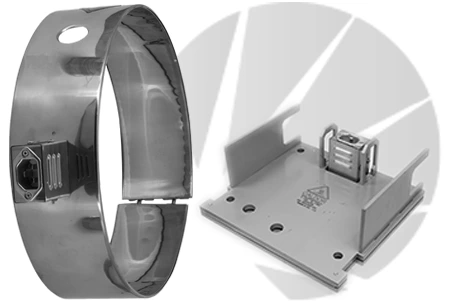
Band and plate heaters must maintain good contact with the surface they are heating. Air gaps, incorrect dimensions or inadequate clamping can reduce heat transfer and create localized overheating.
We manufacture mica, ceramic and custom plate heaters according to the application’s dimensions, temperature and power requirements. Suitable watt density, correct fitting and stable temperature control can improve heat transfer and help extend heater life.
For suitable applications, we can also provide heat-and-cool combinations, integrated temperature sensors and thermal-insulation solutions.
Cartridge Heaters
Cartridge heaters are commonly used in dies, moulds, sealing equipment and industrial tools. The fit between the cartridge heater and its bore plays an important role in thermal performance.
An excessive gap can trap air, restrict heat transfer and raise the internal temperature of the heater. We therefore consider diameter tolerance, heated and unheated zones, watt density, cable connection and sensor requirements when developing a cartridge heater.
Tubular and Finned Heaters
Tubular elements can be designed for heating air, liquids, metal surfaces and industrial equipment. Their geometry, sheath material and surface load should match the operating environment.
Finned tubular elements can increase the available heat-transfer surface in air-heating applications. However, airflow, air temperature and element position must be considered to prevent localized overheating and unnecessary energy use.
Immersion and Flanged Heaters
Immersion heaters transfer heat directly into water, oil and other process media. This creates an effective thermal path, but only when the element material and surface load are suitable for the medium.
We evaluate the tank volume, operating temperature, required heating time, circulation conditions, sheath material, cold zone and safety-control requirements. Correct selection helps protect both the heating element and the material being heated.
Insulation Jackets
Heat lost from an exposed barrel, pipe, valve or flange must be replaced continually.
Removable insulation jackets can help retain process heat and reduce unnecessary heat release into the surrounding workplace. They also provide maintenance access because they can be removed and installed again without destroying the insulation.
The actual benefit depends on the equipment, surface temperature, insulation construction and operating cycle.
Sensors and Control Systems
A heating element cannot operate efficiently without reliable temperature measurement and control.
Thermocouples, PT100 sensors, controllers, solid-state relays and properly designed control panels allow the system to respond to actual process demand. Stable control can reduce overheating, improve product consistency and protect heating equipment from unnecessary thermal stress.
Keeping Existing Equipment in Service
Replacing an entire machine is not always necessary when its original heating system becomes obsolete or unavailable.
Where technically possible, Caldor can inspect an existing heater, identify its electrical and mechanical characteristics and develop a compatible replacement. We can also support retrofit projects involving revised power, improved temperature control, alternative materials or updated connection arrangements.
Extending the useful life of existing machinery can reduce capital expenditure and avoid the material and energy required to replace complete equipment. Every retrofit must, however, be checked for electrical, mechanical and operational compatibility.

Supporting Industrial Electrification
Precisely controlled electric heating can support the transition away from direct fossil-fuel heating in suitable industrial processes.
Electric systems produce no combustion gases at the point of use and can respond accurately to temperature-control requirements. They can also operate with an electricity supply that increasingly includes renewable sources.
However, electric heating should not automatically be presented as emission-free. Its overall environmental impact depends on the source of electricity, system efficiency, operating profile and process conditions.
Caldor can evaluate electric heating for tanks, process vessels, moulds, dies, extrusion machinery, air ducts, pipes, valves, industrial tools and custom production equipment. We recommend conversion only when it is technically safe, operationally suitable and economically reasonable.
From Our Factory to Your Production Line
Our responsibility covers three connected areas.
In our factory, we work to use materials carefully, reduce avoidable waste, separate recyclable materials and limit unnecessary energy consumption.
In our products, we focus on effective heat transfer, appropriate installed power, accurate temperature control and reliable service life.
In our customers’ processes, we provide technical support for heater selection, insulation, sensors, control systems and replacement projects that may reduce unnecessary thermal losses and operating costs.
We cannot make industry more responsible through a single product or a single company. But every correctly designed heater, every avoided material loss and every kilowatt used more effectively moves us in the right direction.
Let’s Review Your Heating Process
If you are developing a new machine, replacing an obsolete heater or looking for ways to improve an existing heating process, our engineering team can review your application.
To begin, send us the available dimensions or technical drawing, voltage, required power, operating temperature, heating time, sensor requirements and information about the material being heated.
Responsible heating begins with understanding the process.
Technical notice: Energy consumption and potential savings depend on system design, insulation, temperature control, installation, operating conditions, maintenance and energy source. Any projected improvement should be confirmed through an application-specific technical assessment or comparative measurement.