
High-Performance Cartridge Heaters for Industrial Applications
Cartridge heaters are compact electric heating elements designed to transfer concentrated heat into molds, dies, metal blocks, tools and industrial machinery.
Although their external construction may appear simple, the performance and service life of a cartridge heater depend on several critical engineering parameters. Diameter, heated length, voltage, total power, watt density, sheath material, internal insulation, cable type and installation tolerance must all be selected according to the application.
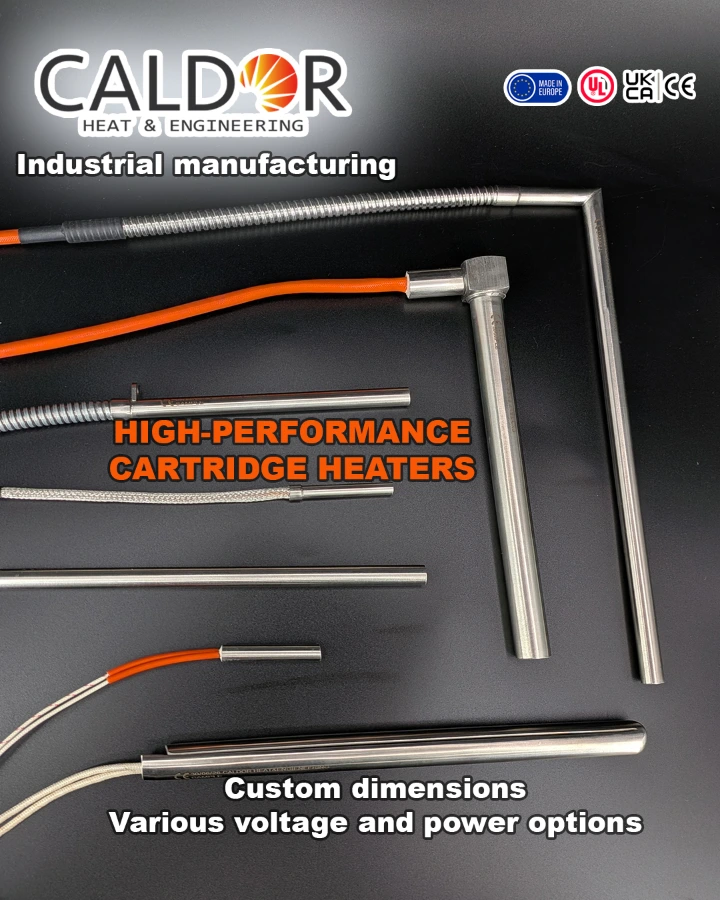
At Caldor Heat Engineering, cartridge heaters are manufactured according to project-specific technical requirements. Custom dimensions, different voltage and power options, alternative connection designs and application-specific materials can be evaluated for both individual projects and serial production.
What Is a Cartridge Heater?
A cartridge heater is a cylindrical electric resistance heater installed inside a machined hole or metal component.
Electrical resistance wire inside the heater converts electrical energy into heat. The generated heat is transferred through compacted electrical insulation and the outer metallic sheath into the surrounding component.
Cartridge heaters are commonly used where high heating power must be delivered from a compact surface area.
Depending on the application, they can provide:
- Fast and controlled heating
- Concentrated heat transfer
- Compact installation
- Stable thermal performance
- Compatibility with temperature controllers
- Custom voltage and power configurations
- Different cable and terminal alternatives
Why Custom Cartridge Heaters Matter
A standard heater is not always suitable for every machine or heating process.
Industrial applications may require a specific diameter, an unusual length, a limited cold section, a right-angle cable exit, a threaded connection or a special cable protection system.
The heater must also be matched to the thermal conditions of the application. Using excessive watt density can create unnecessarily high sheath temperatures. Insufficient power, on the other hand, may result in slow heating and unstable process temperatures.
A correctly engineered cartridge heater balances:
- Required heating time
- Operating temperature
- Heat losses
- Available installation space
- Surface contact
- Electrical supply
- Process control requirements
- Expected operating cycle
The most powerful heater is not automatically the most suitable heater. Correct thermal design is more important than selecting the highest possible wattage.
Main Design Options
Cartridge heaters can be manufactured with different configurations according to the project.
Custom Dimensions
The diameter and length should match the installation hole and available space. Manufacturing tolerances are particularly important because efficient heat transfer requires proper contact between the heater and the surrounding metal.
Voltage and Power
Cartridge heaters can be designed for different electrical supplies. Voltage and total power must be selected together with the required heating time and operating temperature.
Heated and Unheated Sections
Some applications require a controlled heated zone or an unheated section close to the cable connection. This can help protect electrical connections from excessive temperature.
Cable Options
Available connection designs may include:
- Fiberglass-insulated cables
- PTFE-insulated cables
- Metal-braided protection
- Flexible metal conduit
- Straight cable exits
- Right-angle exits
- Threaded terminal connections
- Plug and connector alternatives
The correct cable system depends on temperature, movement, moisture, mechanical stress and installation conditions.
Sheath Materials
The outer sheath must be selected according to temperature, corrosion risk, mechanical conditions and the material being heated.
Stainless steel and special alloy options can be evaluated depending on the application.
Integrated Temperature Sensors
Certain heater designs can be manufactured with an integrated thermocouple or prepared for use with a separate temperature sensor.
A temperature controller, solid-state relay or other control component can then regulate the heating process.
Typical Applications
Custom cartridge heaters are used in many industrial sectors.
Common applications include:
- Plastic injection molds
- Extrusion equipment
- Packaging machinery
- Sealing jaws
- Forming tools
- Hot stamping equipment
- Dies and metal tooling
- Food-processing machinery
- Laboratory equipment
- Heating plates
- Industrial ovens
- Hot runner systems
- Shoe manufacturing equipment
- Automotive production systems
- Special-purpose machinery
Each application has different thermal and mechanical requirements. For this reason, the heater should be selected according to the actual operating environment rather than only according to its external dimensions.
Important Selection Parameters
The following information should be defined before manufacturing a cartridge heater:
- Heater diameter
- Total heater length
- Heated length
- Supply voltage
- Required power
- Maximum operating temperature
- Material being heated
- Installation hole dimensions
- Cable length
- Cable insulation type
- Cable exit direction
- Required sheath material
- Temperature sensor requirement
- Working environment
- Continuous or intermittent operation
- Required quantity
A technical drawing or a sample product can also help determine the correct configuration.
Installation and Heat Transfer
Installation quality has a direct effect on heater performance.
A cartridge heater should be installed inside a correctly machined hole with appropriate contact between the sheath and the surrounding metal. Excessive clearance reduces heat transfer and can cause the heater sheath to operate at a higher temperature.
For reliable operation:
- The installation hole should be clean and correctly machined.
- The heater should not be forced into a damaged or deformed hole.
- Electrical cables should be protected from sharp edges.
- Cable exits should not be subjected to repeated bending.
- Temperature should be controlled with a suitable sensor and controller.
- The heater should not be energized outside its intended operating environment unless it was specifically designed for that condition.
- Moisture, oil, chemicals and vibration should be considered during product selection.
Quality and Electrical Testing
Industrial heating elements must be evaluated both mechanically and electrically.
Depending on the design and project requirements, the manufacturing and inspection process may include:
- Resistance measurement
- Power verification
- Insulation resistance testing
- Electrical leakage testing
- Dimensional control
- Cable and connection inspection
- Surface and sheath inspection
- Marking and traceability checks
Compliance requirements such as CE, UKCA or UL-related configurations must be evaluated according to the specific product, market and technical project.
The presence of a certification logo should only be used when the exact product configuration and documentation support that certification.
Why Work With Caldor Heat Engineering?
Caldor Heat Engineering develops industrial heating solutions according to real application requirements.
Our objective is not simply to supply a heating element. We evaluate the relationship between the heater, the machine, the installation conditions and the required thermal process.
Our cartridge heater capabilities include:
- Custom dimensions
- Different voltage and power options
- Multiple cable configurations
- Alternative sheath materials
- Straight and angled connection designs
- Prototype and serial production
- Technical evaluation based on drawings or samples
- Solutions for molds, machines and special industrial equipment
Request a Technical Quotation
To receive an accurate quotation, please provide:
- Diameter
- Total length
- Voltage
- Power
- Cable length
- Cable type
- Required quantity
- Maximum operating temperature
- Application description
- Technical drawing or product photograph
Our technical team will evaluate the information and recommend an appropriate cartridge heater configuration.
Caldor Heat Engineering
Industrial Heating Solutions
Telephone and WhatsApp:
+40 799 22 55 22
English FAQ
What is a cartridge heater used for?
A cartridge heater is used to heat molds, dies, metal blocks, sealing systems, packaging machinery and other industrial equipment requiring compact and concentrated heat.
Can cartridge heaters be manufactured in custom dimensions?
Yes. Diameter, length, heated section, voltage, power, cable length and connection type can be designed according to project requirements.
How should cartridge heater power be selected?
Power should be calculated according to the material being heated, target temperature, heating time, thermal losses, installation conditions and operating cycle.
Why is the installation hole important?
A correctly machined installation hole provides better contact and more efficient heat transfer. Excessive clearance can increase the operating temperature of the heater sheath.
Can a cartridge heater include a temperature sensor?
Certain designs can include an integrated thermocouple. A separate sensor can also be installed close to the heater, depending on the application.